


Leadership Assessment Comparison: From Personality to Coherence
Leadership assessments have become a central component of modern leadership development. From personality profiling to behavioral models and feedback systems, organizations rely on these tools to improve performance, alignment, decision-making, and culture.
Over time, these assessments have helped leaders understand how they behave, how they are perceived, what motivates them, and where they may struggle under pressure. They have brought structure and shared language into leadership conversations that were once vague or intuitive.
Yet as leadership environments grow more complex, many executives experience a subtle but persistent gap. They have insight into how they lead, but less clarity about why leadership effectiveness sometimes plateaus, particularly during periods of uncertainty, rapid growth, or cultural transition.
This article offers a structured comparison of today’s most widely used leadership assessments and introduces an emerging dimension of leadership measurement: inner coherence.
The leadership assessment landscape today
Leadership assessments have historically evolved in response to specific organizational needs. Most widely adopted tools fall into a few main categories.
Behavioral assessments, such as DISC, focus on observable patterns of action and interaction. They are often used to improve communication, collaboration, and conflict management within teams. Their accessibility makes them particularly useful for onboarding, team workshops, and practical alignment.
Cognitive and typology-based assessments, such as MBTI, explore how individuals perceive information and make decisions. These tools provide language for differences in thinking styles and preferences, supporting mutual understanding and diversity of perspective.
Personality-based assessments, including Hogan and Big Five models, go deeper into stable personality traits, values, and potential derailers under stress. They are widely used in talent selection, succession planning, and executive development because of their predictive value in workplace behavior.
Relational and feedback-based tools, such as 360-degree feedback, capture how leadership is experienced by others. They offer context-specific insight into leadership impact, often revealing blind spots and areas for development that internal reflection alone may not surface.
Fit and selection systems, such as The Predictive Index, combine a behavioral profile with a separate measure of cognitive ability and compare both against a described role. They are used to hire, to place people well, and to design teams that work together.
Each of these assessment families addresses a real leadership question. Many organizations combine several of them to gain a more complete picture.
What they largely share is a focus on personality, behavior, motivation, cognition, and perception.
A visual map of leadership assessments
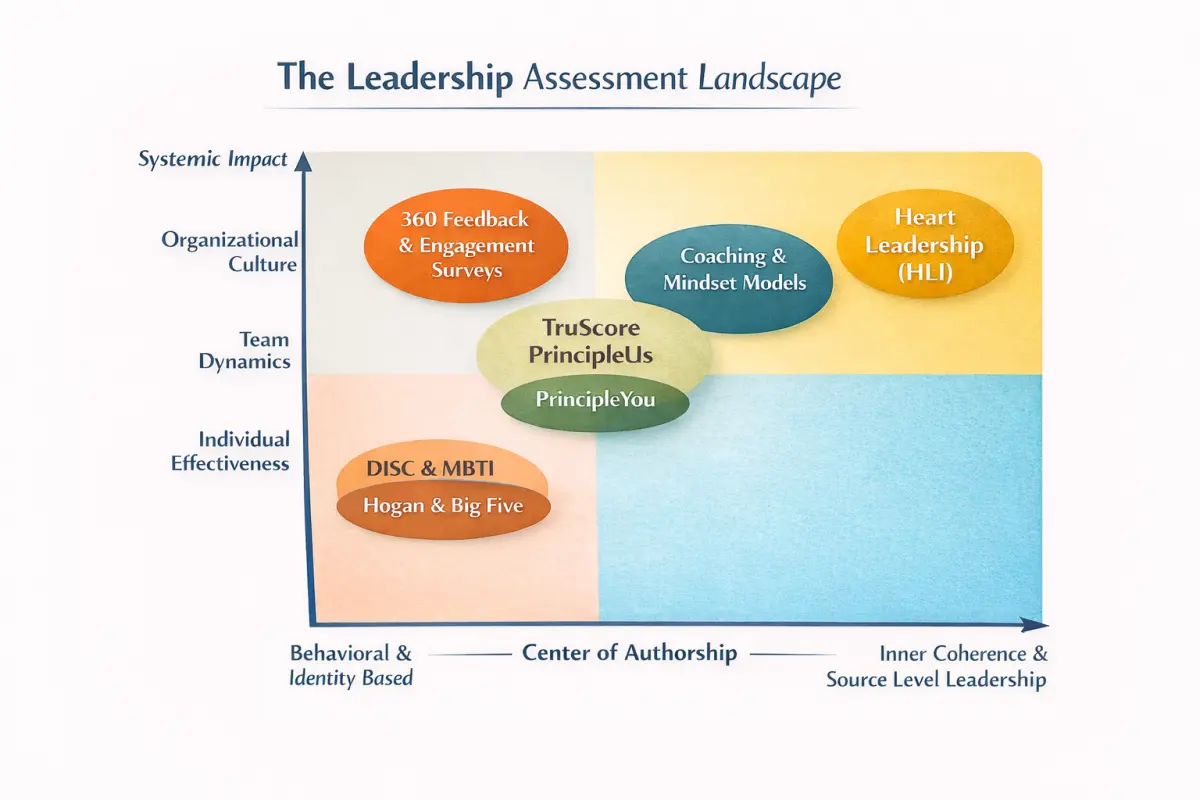
The visual above maps leadership assessments across two dimensions.
The horizontal axis, the center of authorship, reflects where leadership is sourced from internally. On the left, leadership is primarily expressed through observable behavior and identity-based patterns. Moving right, leadership becomes increasingly shaped by inner coherence and source-level alignment.
The vertical axis, the scope of outer impact, reflects how far leadership influence extends. At the lower end, impact is primarily individual. Higher up, leadership shapes teams, organizational culture, and, in some cases, broader systems.
This map does not rank leadership assessments by quality or importance. It situates them according to the layer of leadership they are designed to illuminate.
What traditional leadership assessments do exceptionally well
Traditional leadership assessments offer substantial value, particularly when organizations seek clarity, structure, and comparability.
They help leaders:
Understand their default patterns of behavior
Identify strengths and developmental edges
Anticipate stress responses and potential derailers
Improve communication and collaboration
Receive feedback grounded in observable experience
From an organizational perspective, these tools support:
Hiring and promotion decisions
Succession planning
Team design
Leadership development programs
Cultural diagnostics
In many leadership contexts, this level of insight is sufficient. When challenges are well defined and environments relatively stable, optimizing behavior and managing personality traits can lead to meaningful improvement.
These tools work effectively within identity. They assume a leader who is fundamentally stable and whose effectiveness depends on managing traits, skills, and behaviors well.
The shared boundary: leadership as identity management
Across assessment methodologies, there is a shared implicit assumption: leadership is authored from a stable identity that manages itself and others.
In practice, this means leadership development often focuses on refining:
how a leader shows up
how they regulate emotions
how they communicate
how they influence and decide
For many leaders, this approach works for years.
However, in environments defined by complexity, ambiguity, and rapid change, leaders often encounter limits to identity-based leadership. These limits are rarely dramatic. They show up subtly.
Leaders describe feeling as though they are “holding everything together,” making decisions that carry increasing weight, or compensating internally for organizational uncertainty. Even highly capable leaders may notice rising effort, decision fatigue, or a growing gap between intention and outcome.
At this point, leadership challenges are no longer solely about skills or behavior. They reflect the inner stance from which leadership is being enacted.
Inner coherence as a leadership dimension
Inner coherence refers to the degree of alignment between a leader’s awareness, emotional regulation, intention, and action, as well as their relationship to identity itself.
When coherence is high, leadership tends to feel grounded and responsive. Decisions arise with greater clarity. Actions feel proportionate to the situation rather than reactive. Trust stabilizes without constant effort.
When coherence is fragmented, leadership often becomes effortful. Identity narratives unconsciously shape perception. Leaders may find themselves compensating, over-controlling, or managing internal tension that subtly impacts the organization.
Importantly, inner coherence is not a personality trait. It is a state-based capacity that influences how personality expresses itself across contexts.
This is the dimension measured by the Heart Leadership Index (HLI).
Rather than categorizing behavior or predicting tendencies, HLI assesses seven dimensions of inner coherence, including presence, inner peace, inner joy, non-attachment, selflessness, unity, and purpose. Together, these dimensions describe the leader’s center of authorship beneath personality and role.
How the Heart Leadership Index (HLI) compares to other leadership assessments
Leadership assessments differ not in rigor, but in what layer of leadership they are designed to measure. Below is a high-level comparison.
| Assessment | What it measures | Leadership layer | Best used for | Format |
|---|---|---|---|---|
| DISC | Observable behavioral style and communication preferences | Behavior | Collaboration, onboarding | Self-report |
| MBTI | Cognitive and type preferences, decision-making style | Cognition | Mutual understanding, perspective | Self-report |
| Hogan / Big Five | Stable personality traits, values, and stress derailers | Personality | Selection, succession, risk | Self-report |
| 360-degree feedback | How a leader’s impact is experienced by others | Perception | Blind spots, development | Multi-rater |
| The Predictive Index (PI) | Behavioral drives, cognitive ability, and fit to a described role | Behavior and role fit | Hiring, placement, team design | Adjective checklist plus a timed cognitive test |
| Heart Leadership Index (HLI) | Inner coherence across seven dimensions: presence, inner peace, inner joy, non-attachment, selflessness, unity, purpose | Source, the inner state beneath personality | Stability and adaptability in complexity | Structured self-report, 35 questions, ~7 min |
Heart Leadership Index vs Hogan Assessments
Hogan Assessments measure personality traits, values, and derailers that predict workplace behavior and leadership risk. They are particularly effective in identifying patterns that may impact performance under pressure.
The Heart Leadership Index operates beneath personality, assessing the leader’s inner coherence and relationship to identity. Rather than predicting behavior, it reveals how freely leadership can respond to reality as conditions change.
In short:
Hogan explains how a leader tends to behave.
HLI reveals from where leadership is being authored.
→ Read the full HLI vs Hogan comparison
Heart Leadership Index vs DISC
DISC focuses on observable behavioral styles and communication preferences. It is widely used to improve collaboration and reduce friction within teams.
HLI does not categorize behavior. It examines the internal alignment that shapes behavior, particularly under uncertainty or stress.
In short:
DISC maps behavioral expression.
HLI maps the inner condition shaping that expression.
→ Read the full HLI vs DISC comparison
Heart Leadership Index vs MBTI
MBTI explores cognitive preferences and decision-making styles, offering insight into how individuals process information.
HLI moves beyond typology to assess presence, identity flexibility, and coherence across contexts.
In short:
MBTI describes how people think.
HLI explores how leadership relates to identity itself.
→ Read the full HLI vs MBTI comparison
Heart Leadership Index vs 360-degree feedback
360-degree feedback captures how leadership is experienced by others in a specific context.
HLI complements this by measuring the inner coherence that shapes leadership impact over time.
In short:
360 feedback reflects leadership impact.
HLI helps explain why that impact stabilizes or shifts.
→ Read the full HLI vs 360 feedback comparison
Heart Leadership Index vs The Predictive Index
The Predictive Index reads four behavioral drives and, separately, cognitive ability, then compares both against a described role. It is built for hiring, placement, and team design, and its validation is built around predicting performance in a job.
HLI reads the inner coherence a leader is operating from, which moves as conditions and practice change.
In short:
The Predictive Index matches a person to a role.
HLI reads the state that person is leading from.
→ Read the full HLI vs Predictive Index comparison
Heart Leadership Index vs Principle You / Principle Us
Principle You and Principle Us focus on articulating the principles that guide decision-making, leadership behavior, and collective culture. They help leaders and teams create clarity and alignment by making their operating principles explicit.
HLI operates beneath principles by assessing inner coherence, the internal stability that allows principles to be lived with flexibility rather than enforced cognitively.
In short:
Principle You clarifies what principles guide leadership.
HLI reveals the inner coherence that allows principles to be embodied.
→ Read the full HLI vs Principle You / Principle Us comparison
Heart Leadership Index vs TruScore
TruScore evaluates values alignment, character, and trust, often used to assess cultural fit, integrity, and ethical risk at the leadership or organizational level.
HLI complements this by measuring inner coherence, the internal condition that supports ethical clarity, trustworthy behavior, and sustained leadership impact under pressure.
In short:
TruScore assesses values and character alignment.
HLI reveals the inner coherence that allows values to be lived consistently.
→ Read the full HLI vs TruScore comparison
Choosing the right leadership assessment
No single assessment answers every leadership question.
Personality tools support selection and risk awareness.
Behavioral tools support communication and collaboration.
Relational tools support feedback and culture.
Inner coherence tools support clarity, adaptability, and leadership in complexity.
Organizations increasingly combine these layers to gain a more complete understanding of leadership.
Why coherence measurement is emerging now
As environments become less predictable, leadership effectiveness depends less on optimizing traits and more on stabilizing the inner field from which decisions emerge. Coherence, treated as a leadership operating system, makes that inner field practical to run.
Leaders operating with higher coherence tend to navigate uncertainty with greater ease, reduce organizational friction, and enable adaptive reorganization without excessive effort.
This shift explains the growing interest in assessments that make the foundational layer of leadership visible and measurable.
Exploring the Heart Leadership Index
The Heart Leadership Index offers leaders a way to explore inner coherence as a measurable dimension of leadership.
Many leaders choose to engage with HLI alongside existing assessments to gain visibility into the layer that shapes all others. It also works as a leadership self-assessment a leader can retake to track how coherence shifts over time.
You can explore the Heart Leadership Index. If you are a coach rather than a leader, the same ground is covered from your side of the table in executive coaching tools.
Frequently Asked Questions
What is the difference between a personality assessment and a coherence assessment?
Personality assessments describe traits and tendencies that shape how leaders behave. Coherence assessments explore the inner alignment that shapes how those traits express under pressure, uncertainty, and change.
Can I use more than one leadership assessment together?
Yes. Many organizations combine assessments: behavioral tools for communication, personality tools for selection and risk, and coherence tools for leadership stability and cultural transformation.
When does inner coherence become most important for leaders?
Inner coherence becomes especially important in complex environments: rapid growth, high uncertainty, cultural change, and high-stakes decisions.
Is the Heart Leadership Index a personality test?
The Heart Leadership Index measures inner coherence across seven dimensions such as presence, inner peace, inner joy, non-attachment, selflessness, unity, and purpose. It focuses on the source of leadership, rather than categorizing personality.
What should I choose if I want to improve team collaboration quickly?
Behavioral tools like DISC can help teams build shared language and improve day-to-day collaboration. Inner coherence tools like HLI support deeper leadership stability and cultural alignment over time.
What are the best leadership assessment tools?
The right tool depends on the question you are answering. Behavioral tools like DISC support collaboration. Personality tools like Hogan and the Big Five support selection, succession, and risk. Relational tools like 360-degree feedback reveal how leadership is perceived. Coherence tools like the Heart Leadership Index measure the inner state from which leadership is authored, supporting stability in complexity. Many organizations combine layers rather than relying on one.
How does The Predictive Index compare to a coherence assessment?
The Predictive Index reads behavioral drives and cognitive ability, then matches a person to a described role. Its evidence base is built around predicting performance in a job, and its results are designed to stay stable for years. A coherence assessment such as the Heart Leadership Index reads the inner state a leader is operating from, which moves with practice and pressure, and is taken again to show direction. The two answer different moments: one at the point of a decision about a person, the other across a development period.
What are alternatives to DISC and MBTI for assessing leaders?
DISC and MBTI describe behavioral style and cognitive preference. Leaders who want more depth add the Big Five or Hogan for stable traits and derailers, 360-degree feedback for perceived impact, or the Heart Leadership Index for inner coherence, the state-based capacity that shapes how any personality expresses under pressure. Each answers a different layer.
Which behavioral assessments predict leadership effectiveness?
Personality-based tools carry the strongest predictive evidence: Hogan and Big Five models link stable traits and stress derailers to leadership performance and risk. The Predictive Index predicts fit to a described role. 360-degree feedback shows how a leader’s effectiveness is experienced by others. The Heart Leadership Index adds the inner coherence a leader operates from, which shapes how steadily those traits express under pressure.
How does Hogan compare to Big Five-based assessments?
Hogan builds on the Big Five model of personality and extends it in two directions: the Hogan Development Survey reads derailers that surface under stress, and the Motives, Values, Preferences Inventory reads what drives a leader. Big Five instruments describe the five broad traits on their own. Both describe stable personality. The Heart Leadership Index reads the state-based coherence beneath it.