


Heart Leadership Index vs DISC
Behavioral Styles and Inner Coherence Compared
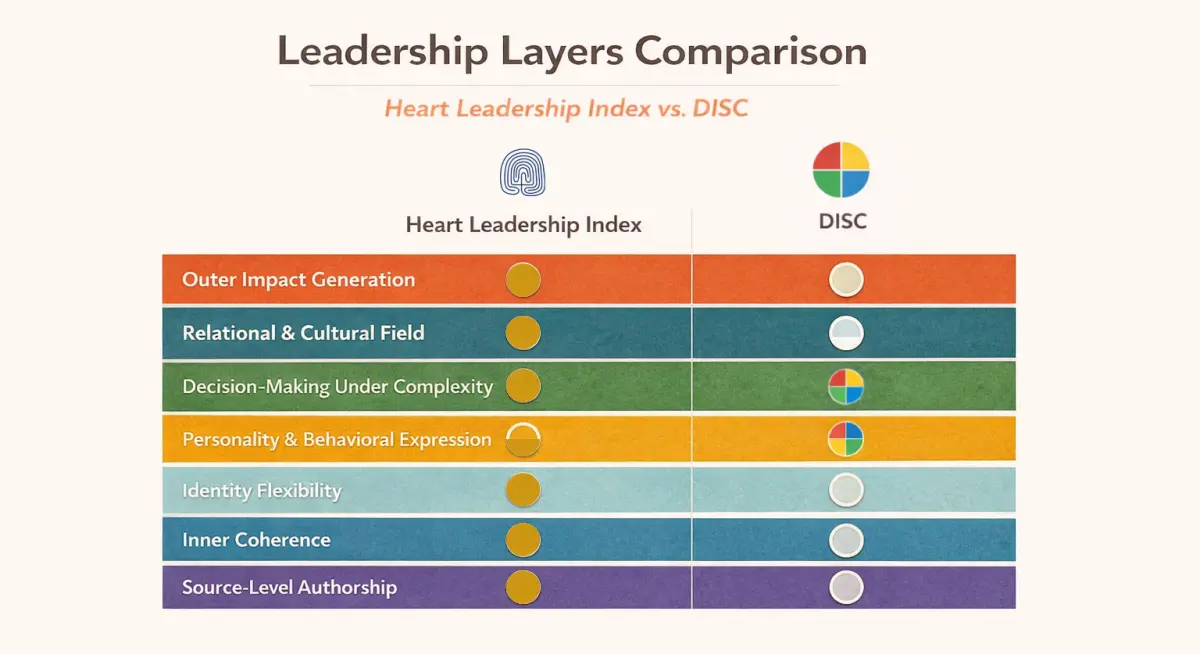
DISC is one of the most widely used leadership and behavioral assessments in the world. Its simplicity and accessibility have made it a staple for improving communication, collaboration, and self-awareness across teams.
The Heart Leadership Index (HLI) approaches leadership assessment from a different angle. Rather than categorizing behavior, it measures inner coherence as the foundation from which leadership behavior, decisions, and impact emerge.
This article explores how DISC and HLI operate at different layers of leadership and when each is most useful. It is part of a broader framework comparing leadership assessments across levels of depth and impact. For the full landscape view, see Leadership Assessment Comparison: From Personality to Inner Coherence.
How to read the visual comparison
The visual above compares DISC and HLI across seven leadership layers, from outer impact generation at the top to source-level authorship at the foundation.
Each circle represents how directly an assessment addresses that layer:
- ● Primary focus
- ◐ Indirect influence
- ○ Not a core focus
The visual is not a ranking. It shows where each tool is designed to operate.
Summary comparison table
The table below summarizes the primary differences between DISC and the Heart Leadership Index.
| Dimension | Heart Leadership Index (HLI) | DISC |
|---|---|---|
| Primary focus | Inner coherence and authorship | Observable behavioral styles |
| Leadership layer | Beneath identity and behavior | Behavior and communication |
| What is measured | State-based, developable coherence | Style preferences and tendencies |
| Response to complexity | Direct and adaptive | Indirect |
| Orientation | Experiential and developmental | Descriptive and practical |
| Time horizon | Longitudinal | Situational |
| Role in ecosystem | Foundational | Complementary |
Core focus: behavior versus coherence
DISC is designed to make behavior visible and understandable. It categorizes observable patterns into four primary styles: Dominance, Influence, Steadiness, and Conscientiousness. The goal is not prediction or diagnosis, but practical awareness. DISC helps people recognize how they tend to act and how others may experience them.
HLI begins upstream of behavior. Its core focus is inner coherence, the alignment of awareness, emotion, intention, and action. From this perspective, behavior is an expression of inner state rather than a fixed style to manage.
This distinction explains why DISC is widely used for improving day-to-day interactions, while HLI is used to explore the deeper conditions that shape leadership effectiveness over time.
What they measure
DISC measures behavioral expression. It highlights tendencies in how people communicate, take action, respond to pace, and handle structure. These insights are immediately usable and often intuitive, which is why DISC is popular in workshops, onboarding, and team development settings.
HLI measures seven dimensions of inner coherence:
- Presence
- Inner Peace
- Inner Joy
- Non-Attachment
- Selflessness
- Unity
- Purpose
Rather than labeling how someone behaves, HLI reveals how a leader relates to attention, emotion, identity, and connection. It provides insight into why behavior changes across contexts rather than classifying behavior itself.
Underlying philosophy
DISC is grounded in the idea that behavior can be observed, described, and adapted. By increasing awareness of one’s style and the styles of others, individuals can adjust communication and reduce friction.
HLI is grounded in a coherence-based model of leadership. It assumes that leadership quality depends less on managing behavior and more on stabilizing the inner conditions from which behavior arises. From this view, sustainable change occurs when coherence increases, not when behavior is merely adjusted.
These philosophies are complementary rather than opposed. They operate at different depths of the leadership system.
Typical use cases
DISC is commonly used for:
- team communication and collaboration
- conflict awareness and resolution
- onboarding and training
- leadership workshops and offsites
It is particularly effective when the goal is shared language and immediate practical alignment.
HLI is typically used in contexts such as:
- leadership coherence and clarity development
- mapping alignment across leadership teams
- supporting cultural transformation
- working with leaders in complex or high-ambiguity environments
HLI is most relevant when leadership effectiveness depends on inner stability rather than style adaptation.
Output and interpretation
DISC produces clear, easy-to-understand profiles that describe behavioral tendencies. Results are typically self-interpreted or facilitated in group settings and are designed for immediate application.
HLI produces a coherence profile across internal dimensions, along with insights tied to reflective and embodied practices. At the team level, it highlights coherence patterns that influence trust, decision-making, and impact.
The emphasis is on development over time, not situational adjustment alone.
Who each assessment serves best
DISC is well suited for organizations and teams seeking:
- a simple and accessible behavioral framework
- improved communication and collaboration
- shared language around differences
- fast, practical application
HLI is best suited for leaders and organizations ready to:
- explore leadership beyond behavior and style
- cultivate inner clarity as a leadership capacity
- address complexity and uncertainty at the source
- align inner state with cultural and impact outcomes
In simple terms
DISC helps people understand how they tend to behave and communicate.
HLI helps leaders understand how inner coherence shapes behavior, decisions, and impact.
Many organizations use DISC to improve interaction and HLI to work at the foundation that sustains leadership effectiveness.
Take the Heart Leadership Index — it is free and takes about seven minutes.
Frequently asked questions
What does the DISC assessment measure for leadership styles?
DISC categorizes observable behavior into four styles: Dominance, Influence, Steadiness, and Conscientiousness. It describes how a leader tends to communicate, take action, and handle pace and structure. It reads behavioral expression, not the inner state beneath it.
Is DISC or the Heart Leadership Index better for leaders?
Neither is better; they read different layers. DISC makes behavioral style visible and suits communication and team collaboration. The Heart Leadership Index reads inner coherence, the state from which behavior arises, and suits leaders working on stability and clarity in complexity. Many leaders use both.
Can you use DISC and the Heart Leadership Index together?
Yes. They are complementary. DISC improves day-to-day interaction and shared language, and the HLI works at the foundation that shapes behavior over time. Using both gives a leader the outer style picture and the inner coherence baseline.
What does the Heart Leadership Index measure?
It measures inner coherence across seven dimensions: presence, inner peace, inner joy, non-attachment, selflessness, unity, and purpose. It is a structured self-report questionnaire that reads a leader’s own responses, not behavior or physiology.
Related comparisons
See how the HLI compares with other leadership assessments: HLI vs MBTI, HLI vs 360-degree feedback, or the full leadership assessment comparison overview.
Sources and references
- DISC overview (general):
https://www.discprofile.com/what-is-disc - Behavioral style models overview:
https://en.wikipedia.org/wiki/DISC_assessment - Heart Leadership Index (HLI):
https://test.tapuat.com/defrag - Heart Leadership and coherence research:
https://test.tapuat.com/studies/