


A leadership team sits down for its Monday review. The numbers are strong. The plan is clear. A decision the team closed last month is back on the table, and the meeting runs over again.
You have sat in that room. The company is moving faster than it was a year ago, and something that used to hold has started to shake.
Capital, AI and the human line
Capital is an accelerator. It always has been. Put capital behind a company and everything it does goes faster.
AI now accelerates capital. Faster analysis, faster execution, agents that pay, invest and decide.
An AI model repeats the same decision at nine in the morning, at three in the afternoon and at midnight. That is its strength. The person making the call carries the growth potential, and a state. That state moves through the day: after a short night, in a cash squeeze, in the middle of a negotiation. Every call is taken from wherever the state is at that moment.
Leaders still run at human speed. The gap between that speed and the speed of everything around them is where leadership risk sits.
A wheel on the motorway
Take a car wheel a few grams out of balance. In town, at thirty, you feel nothing. On the motorway, at one hundred and thirty, the whole car shakes.
The force of that imbalance grows with the square of the speed. Double the speed, four times the force.
The imbalance was there all along. Speed revealed it.
This is mechanics, used here as a picture. A company is far more complicated than a wheel. The picture still shows what leaders feel: a tension that costs nothing at low speed becomes expensive at high speed.
In a leader, the imbalance is a tension carried into every decision. Focus against overload. Control against delegation. Vision against execution. At low speed, it passes unnoticed. At this speed, it shows up as slower decisions, conflicting priorities, and friction between people who agree on the plan.
What physicists call decoherence
Physics has a precise word for losing this. A system is coherent when its parts move in step and act as one. Decoherence is how it loses that. Three findings from that field make useful analogies for a leadership team.
The first is that the environment drives it. A coherent system loses coherence through contact with everything around it: heat, vibration, stray signals. No part has to fail. Contact is enough. For a leadership team, the environment is the market, the board, the next funding round, the tool that changed the workflow last week.
The second is that bigger systems lose coherence faster. Five leaders share 10 connections. Fifty share 1,225. Each new leader has to stay in step with everyone already there, so doubling a team roughly quadruples the links that must hold. A team, a growing company, a portfolio: each level adds people who must move together, and more places where coherence can break.
The third is that coherence lasts only through active work. Quantum computers show it. Their qubits can lose coherence within fractions of a second, so a large part of the engineering goes into protecting it. In leadership, that protection is practice.
These findings come from physics, and here they are analogies. The evidence about leaders has to come from leaders.
From decoherence to fragmentation
Two words help keep this clear. Decoherence is the process: what speed and scale do to a company over time. Fragmentation is the state: what you can read in a leader or a team at a given moment.
Coherence is the alignment between what a leader thinks, feels, decides and does. When the four point the same way, they add up, and speed becomes performance: on time, together, once. When they point in different directions, the same energy cancels itself out, and speed becomes risk: late, alone, twice.
Reading the state
A state can be read. The Heart Leadership Index is a 7-minute, 35-question self-assessment across seven dimensions: Focus, Steadiness, Energy, Letting go, Openness, Connection and Direction. It asks leaders precise questions about their own experience. The shape of the reading shows the type of coherence. The overall score shows its level. The instrument is internally validated across 700+ participants, with peer review in progress.
Read again every 90 days, it gives a leadership team a measured result it can report. Here is how the cycle works.
The talk
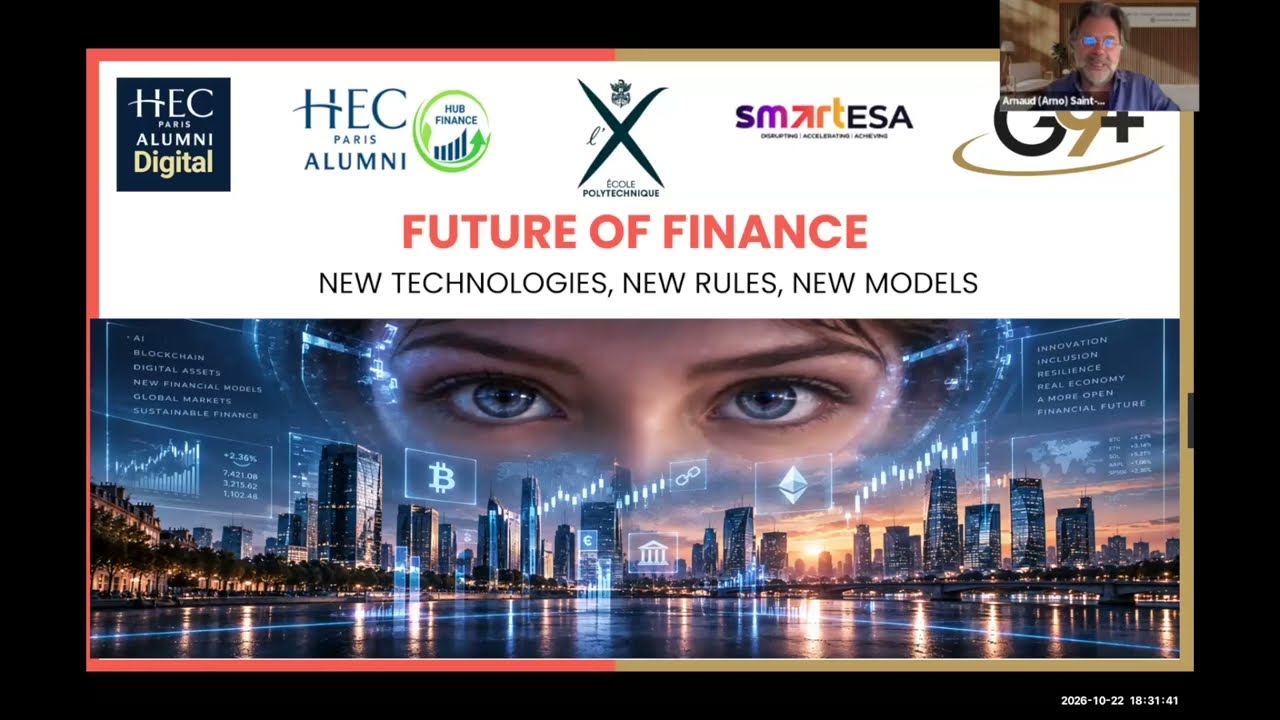
This argument comes from a seven-minute talk at the HEC Alumni event The Future of Finance, in October 2026.
Seven minutes to listen. Seven minutes to read your own.
Before you read anyone else’s, read your own.
Measure your own leadership coherence
The Heart Leadership Index is a structured self-assessment: 35 questions across seven pillars, about seven minutes, and your map is yours to read.
Take the HLI free